GEZELLIG-NEPA.COM
  • Home
  • Gezellig Services
    • Rhythmic Connections
    • Listening Room
    • Briggs Farm Blues >
      • Blues 2025
      • Blues 2016
      • Blues 2010
    • Area 51 >
      • A51 Season 1-3
      • A51 Season 4-6
      • A51 Season 7-9
      • A51 Season 10-12
      • A51 Unsubscribe
    • Columbia-Montour Visitors Bureau
  • About Us
    • Our Herstory 1970s >
      • Tin Ear Sound & Stage
      • Ozymandias
      • Goodman Brothers
      • Summer of 76
      • Folly Magazine
    • Our Herstory 1980s >
      • COMMUNITY
      • ACTIVISM
    • PETS
    • Quilting
    • FART
  • Travel
    • Fodor's
    • Bloomsburg, PA
  • Genealogy
    • Madara History >
      • Joseph Madara Sr WWII
      • Madara Swiss Ancestors
      • Madara Revolutionary War
      • Gilberton Sensation
      • Madara Photos
      • Madara Reunions 1964-1997
      • Madara Reunions 2013-present
    • Kehres History >
      • Kehres Photos
    • Jay History >
      • Burke W Jay WWII >
        • Burke W Jay Combat
      • Who's Henry Goldner
      • Goldner Years
      • Thomas Hunt of Grove Farm
      • Edward Jessup of West Farms
      • Jay Photos
  • Contact
  • Home
  • Gezellig Services
    • Rhythmic Connections
    • Listening Room
    • Briggs Farm Blues >
      • Blues 2025
      • Blues 2016
      • Blues 2010
    • Area 51 >
      • A51 Season 1-3
      • A51 Season 4-6
      • A51 Season 7-9
      • A51 Season 10-12
      • A51 Unsubscribe
    • Columbia-Montour Visitors Bureau
  • About Us
    • Our Herstory 1970s >
      • Tin Ear Sound & Stage
      • Ozymandias
      • Goodman Brothers
      • Summer of 76
      • Folly Magazine
    • Our Herstory 1980s >
      • COMMUNITY
      • ACTIVISM
    • PETS
    • Quilting
    • FART
  • Travel
    • Fodor's
    • Bloomsburg, PA
  • Genealogy
    • Madara History >
      • Joseph Madara Sr WWII
      • Madara Swiss Ancestors
      • Madara Revolutionary War
      • Gilberton Sensation
      • Madara Photos
      • Madara Reunions 1964-1997
      • Madara Reunions 2013-present
    • Kehres History >
      • Kehres Photos
    • Jay History >
      • Burke W Jay WWII >
        • Burke W Jay Combat
      • Who's Henry Goldner
      • Goldner Years
      • Thomas Hunt of Grove Farm
      • Edward Jessup of West Farms
      • Jay Photos
  • Contact

Burke W Jay WWII COMBAT History
Picture
After spending more than a year and a half training state-side, learning how to be a soldier and a navigator, on 15 Aug 1944 Burke began the second chapter of his war history - COMBAT.

Burke Jay's WWII History
​
​COMBAT
​15 Aug 1944 - 13 Oct 1945

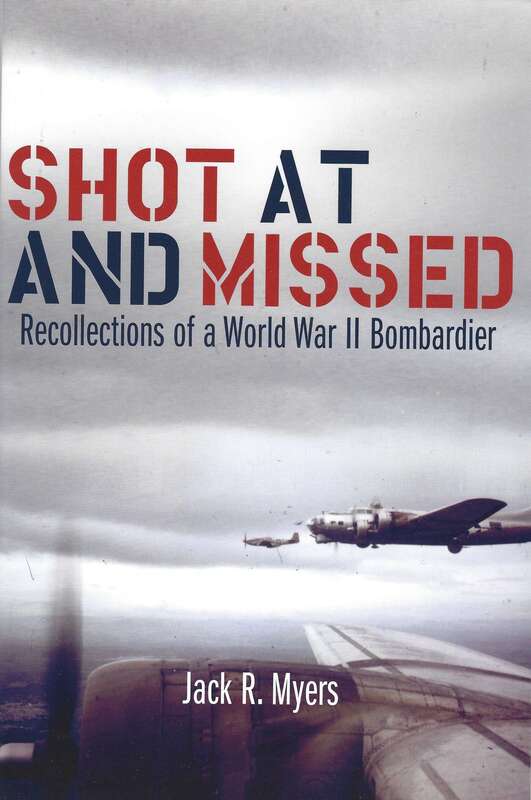
For the COMBAT chapter of Burke's WWII history, I have used his letters that he sent home to family, and also relied on the book Shot at and Missed: Recollections of a World War II Bombardier by Jack R. Myers.

As the bombardier and navigator, respectively, Jack and Burke became close friends while serving together in the front belly of their plane. Because Jack held the rank of 2nd Lt., he was able to self-censor his own mail, allowing his letters home to his brother to be much more descriptive of his wartime exploits. In contrast, Burke’s almost daily letters were more watered-down, as he did not want to alarm his parents or sister. 
Picture
Jack even dedicated a chapter of his book to Burke, titled "Jaybird." This account has provided our family with a vital understanding of Burke's experiences during the war, which he otherwise chose not to speak about.  Thank you, Jack.
Burke's Crew
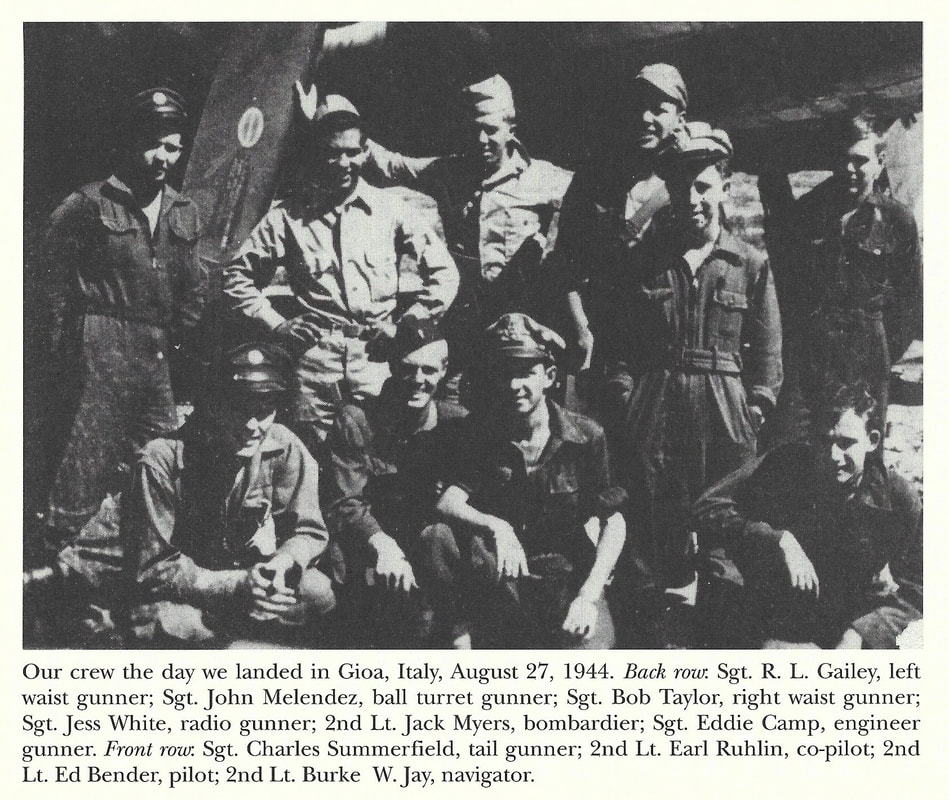
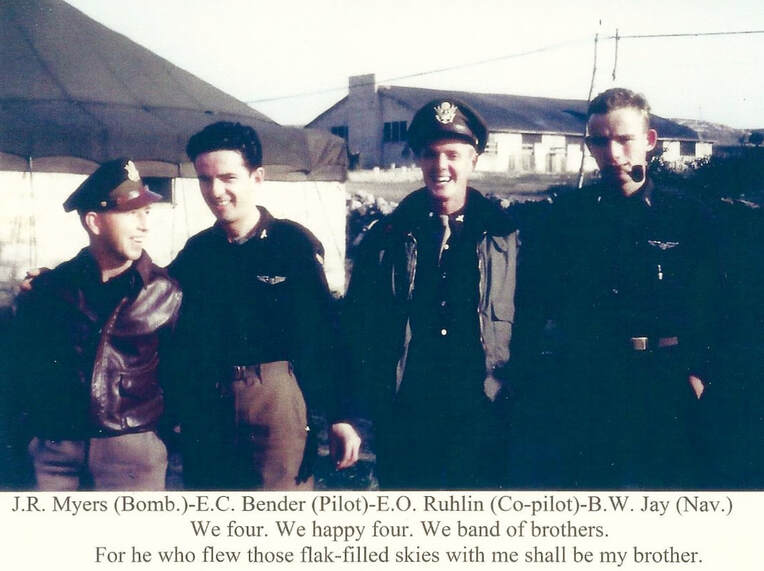
  • ​​2nd Lt  Ed C Bender - Pilot
  • 2nd Lt  Earl O Ruhlin - Co-Pilot
  • 2nd Lt  Jack R Myers - Bombardier
  • 2nd Lt  Burke W Jay - Navigator
  • Sgt  Charles Summerfield - Tail Gunner
  • Sgt  Jess White - Radio Gunner
  • Sgt  Ralph Gailey - Left Waist
  • Sgt  Bob Taylor - Right Waist
  • Sgt  Johnny Melendez - Ball Turret
  • Sgt  Eddie Camp - Engineer & Upper Turret Gunner
Picture
Flying to Places Unknown
15 Aug 1944 - 29 Aug 1944
On the 15th of August, Burke and his crew began the long trip overseas in their new B-17 bomber  plane, their Flying Fortress, leaving from Hunter Army Air Field in Savannah, GA.

They would take the northern route, flying up the Atlantic seaboard. They flew over Palmyra, NJ, within 5000 feet above Burke's home, passed over Ed Bender's (pilot) home in Jersey City, NJ, then circled the Empire State Building in New York City. 

They landed at Dow Field in Bangor, ME, where the crew would spend a few days. While there, Earl Ruhlin (co-pilot) was able to meet up with his wife and kiss her good-bye, never knowing if they would see each other again. Gander Field in Newfoundland would be their next stop on the journey to who-knows-where.


After several days, the crew received their next orders to fly south to the Azores Islands, located about 500 miles off the coast of Portugal. It was then that they realized their final destination would be Italy, where they would serve as part of the Fifteenth Air Force.

This would be their first extended trip over water, and they would be flying at night. The crew took off at 1 a.m., and around 4 a.m., they encountered a thunderstorm that produced St. Elmo's Fire. This natural phenomenon created a bluish-green light dancing on the plane. It occurs when the ground below is electrically charged, resulting in high voltage in the air between the clouds and the ground.  They eventually landed at their destination, and were able to spend the day.

The next morning the crew was on their way to Marrakech, French Moroco, North Africa, where they stayed in a French Foreign Legion Officer's Quarters, and had their first experience with a bidet.

The following morning they flew to Tunis, along the northern coast of Tunisia, across the Mediterranean Sea from Italy. 
Picture
Photo From: Shot at and Missed by Jack Myers
The next morning, on 27 Aug 1944, the crew finally landed in Gioa, Italy, where they spent 2 days and nights in a staging area, sleeping under the wings of their aircraft, waiting for their next order. 

The morning of 29 Aug 1944, the crew arrived in Tortorella, Italy, home of the 99th Bomb Group, their new assignment. "Combat at last!," Jack exclaimed, in his book. 
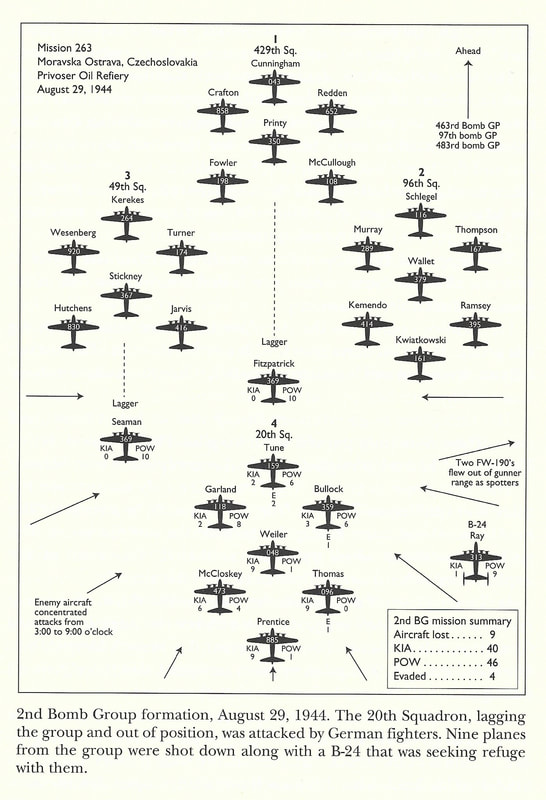
Little did they know that while they were flying to Tortorella, the 2nd Bombardment Group—consisting of four squadrons with seven planes each—was en route to the Privoser Oil Refinery in Czechoslovakia. During the mission, the group was attacked by German fighters, wiping out most of the 20th Squadron, resulting in a tremendous loss for the American forces.
  • Aircraft lost  -  9
  • KIA  -  40
  • POW  -  46
  • Evaded  -  4
Picture
Photo from: Shot at and Missed, by Jack Myers
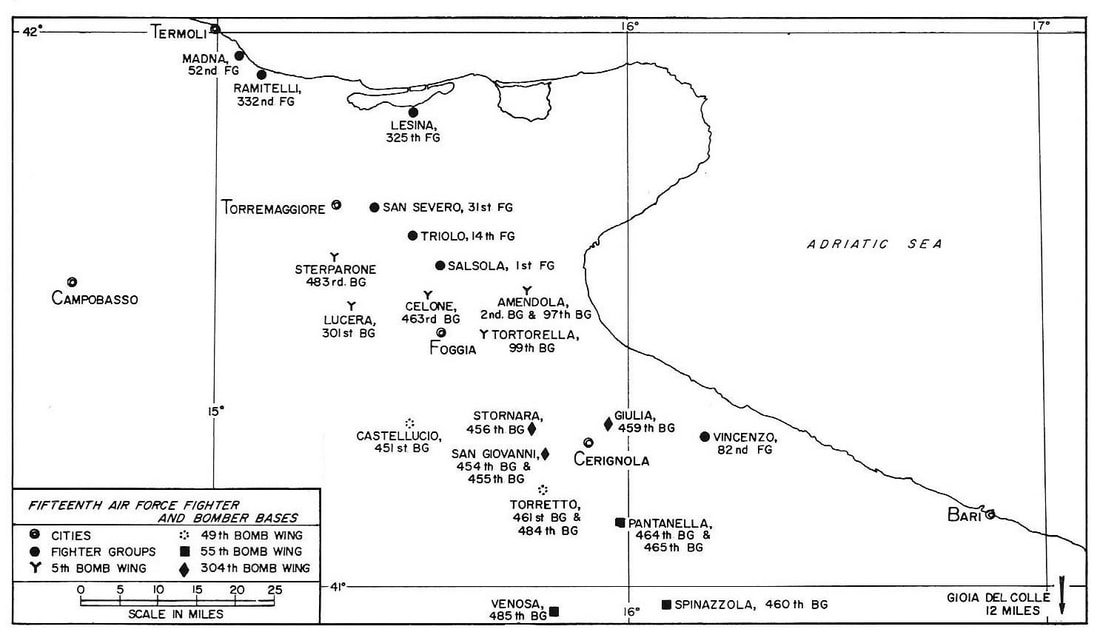
The crew were barely on the ground in Tortorella for an hour, when they were ordered north to the next airfield, which turned out to be Amendola Air Base, located near Foggia, Italy, the home of​ the 2nd Bombardment Group. Upon their arrival, the four officers of the crew were escorted to an area with a "cluster of tents and small huts with stone walls and canvas tops."  They were told to, "pick one. They're all empty." The rookie soldiers quickly realized that they were re-assigned to Amendola to replace members of the fallen 20th Squadron.  They were just another group of warm bodies in this revolving door to hell.  Amendola would be home until they could complete 50 successful bombardment  missions, if they were lucky. By the end of the day, Jack Myers wasn't feeling as enthusiastic about going into COMBAT.  
Picture
Fifteenth Air Force Fighter and Bomber Bases near Foggia, Italy
Picture
Bombing Missions from Amendola
30 Aug 1944 - 9 Dec 1944
While I do not have a specific list of the missions Burke completed, I have compiled a list based on the missions Jack detailed in his book, and Burke mentioned in his letters home to family. Since they flew together most of the time, it is highly likely they participated in the same missions, even on the rare occasions they were not in the same aircraft.
By 2 Sep 1944, Burke and his fellow officers were living in a house, with a cement floor, that the natives built for them for $180. In a letter back home he reports, "To get running water you have to have a tank to give you pressure and the ground is soft and when we try to fill our tank the frame that holds it up starts to sink. When we get a little time we are going to build a rock foundation and that should make things work out OK. We also got a little heater which has to be installed to give us running hot water. It sure is a lot of fun fixing the house up and it is something to do in our spare time."  When he wasn't busy housekeeping, Burke would also go swimming in the Adreatic Sea, near the town of Manfredonia. Spare time will soon be something in the past for Jack, Burke, Ed, Earl, and the rest of their crew. 

On 5 Sep 1944, Burke requested his family to send a camera to him, so he could photograph his crewmates, friends, and adventures, etc. "Maybe daddy can get a little camera with a far lense and some film and send it to me, I would sure appreciate it. You see we can take all the pictures we want and if any have military information etc. the army will keep them until after the war and then I could get them."

Bombing Missions from Amendola
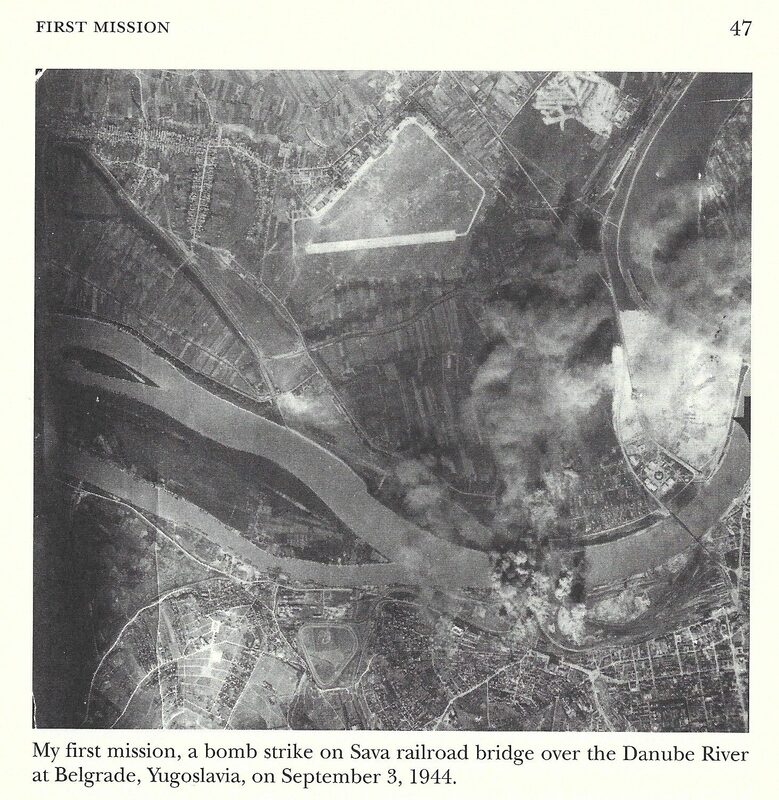
  • ​3 SEPT  - Their FIRST MISSION - Belgrade, Yugoslavia, along the Danube - Sava Railroad Bridge
  • 5 SEPT  - Hungary - Railroad Bridge
  • 6 SEPT  - Oradea, Rumania - Marshalling Yards near the Russian line
  • 8 SEPT  - Brod, Yugoslavia - Marshalling Yards
  • 10 SEPT  - Vienna, Austria - Lobau Oil Refinery
  • 12 SEPT  - Lechfield, Germany - Airfield
  • 15 SEPT  - Athens, Greece - Kalamaki Airdrome
  • 17 SEPT  - Budapest, Hungary - Rakos Marshalling Yards
  • 18 SEPT  - Subotica, Yugoslavia - Marshalling Yards
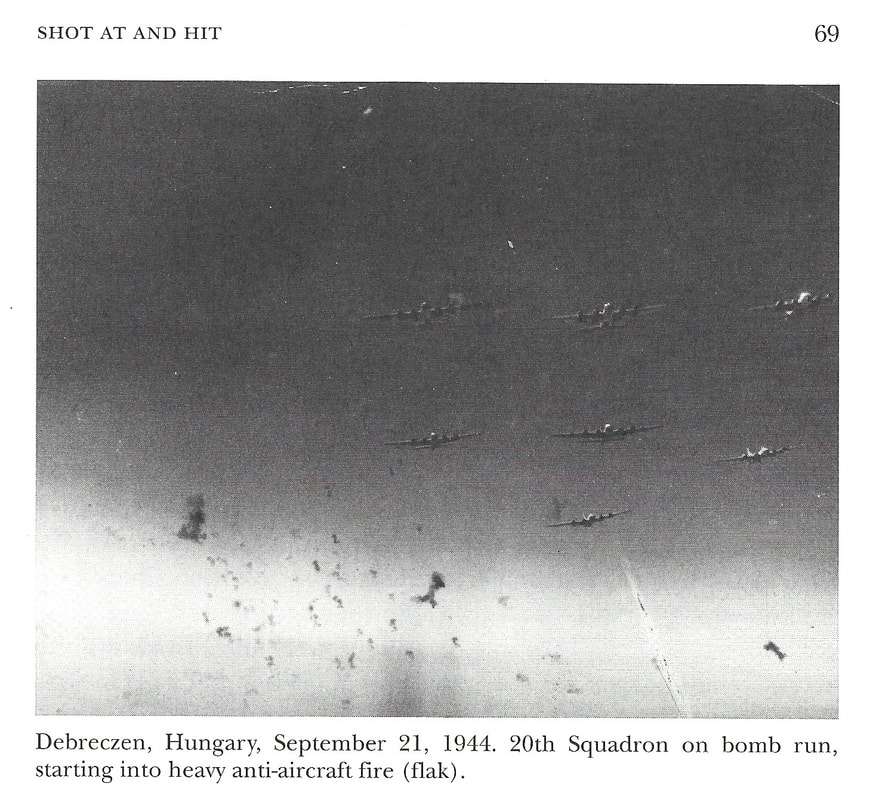
  • 21 SEPT  - Debreczen, Hungary - Marshalling Yards
  • 23 SEPT  - Brux, Czechoslovakia - Synthetic Oil Refinery
Picture
Photo from: Shot at and Missed, by Jack Myers
On their first mission, Ed served as co-pilot to Bill Campbell, a seasoned veteran. It was a harrowing operation that required the crew to apply every skill from their training to ensure they could complete the mission and return safely to their little hut at Amendola Air Base.

With each mission they flew, the crew became more comfortable with their responsibilities.  At the same time, no two missions were the same, so they were constantly improvising and making split-second life-or-death decisions. 

In a letter home, dated 13 Sep 1944, Burke inquired about the status of the camera that he requested. "Did daddy find out anything about the camera yet?"
September 15th we find Burke and crew bombing the Kalamaki Airdrome near Piraeus, just outside of the port city of Athens. Jack wrote, "We were warned not to fly over the city proper since they wanted us to stay clear of the Acropolis, the Parthenon, and other ancient sites. They didn't want us to accidentally bomb those historic places."  Burke memorializes the day's events in his letter of 15 Sep 1944, "I have been over Greece and I saw the city of Athens, but I didn't see any marathon runners."

The next day, while writing his daily letter home to mom, he reflects on the temperatures he must bear while flying. "Things aren't very bad over here. When I fly I have to get up early and sometimes the missions are rather hard. What makes them tiresom is that we are on oxygen most of the time. That, plus the cold. On one mission it was minus 40ºC. That is equal to minus 40ºF, below freezing too. That is funny at those two temps I mention are the only time the two temp scales are equal. I still remember a little about my school work. You might not understand what I mean but daddy will."​

Check out the YouTube video below, which describes the type of gear a B-17 flyer must wear.
We learn more about the censorship of the mail in a letter dated 19 Sep 1944. "The censor has been made a little liberal and I can now tell how many missions I have in. As of today I have 10 missions completed which isn't bad comparing the time I have been here."

From a letter dated 23 Sep 1944:  Mission Update - "I now have 13 missions in. Maybe I will be home for Xmas."  Camera Update - "​I hope daddy can get me a camera. I will be able to get some pictures of our plane in the air and we can send home as long as the tail is not in the picture because the tail has the army and squadron numbers on it and they don't want them disclosed until after the war."
​On 25 Sep 1944, in a letter home to family, Burke reports , "I got 15 missions in so far and I am coming along fine." Of course, he would never let his family know the extent of danger that he was skirting around.

​He also mentions, "Yesterday Bender and Jack Myers my Bombardier and I took our coca and whiskey rations and had some High Balls. We were even able to get some ice. They sure tasted good. I am in our house writing this letter and it is raining outside. Rain sounds funny on a canvas roof."

The following day, 26 Sep 1944, he answers a question from his family. "You asked me to tell you about my missions. Well there isn't much I can say. It is just like flying in the states, only we go a little higher and once in awhile they shoot at you. A lot of the times we pass over a target mission and I can pick out several big lakes which I know by heart. Some of the lakes in the alps are big and so blue that they look green from the air if this is possible. Also I can see the crevices in the snow on top of the mountains so you can imagine how big they are."

In Jack's book, Shot at and Missed, he explains why so many planes can receive damage and still survive. "The B-17 bomber was probably the most durable aircraft ever built. It was 75 feet long and had a 103-foot wingspan, so there was lots of surface area on the plane to take minor damage. These planes were not pressurized like today's planes. You could knock a hole in a B-17 the size of a manhole cover and as long as the controls or engines were okay it would fly. Maybe it couldn't maintain altitude, but on three engines it would do fine. On two engines it could still limp a hundred miles or so at low altitude."
Picture
Photo from: Shot at and Missed, by Jack Myers
Picture
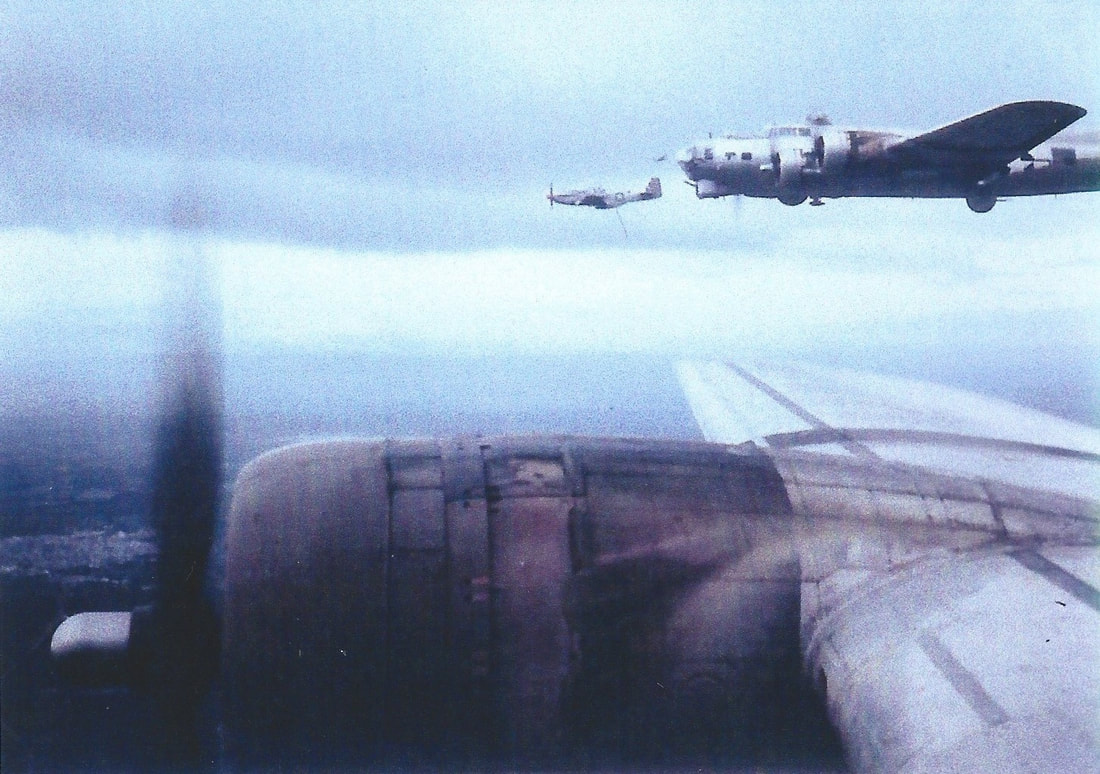
Photo by Earl Ruhlin - two B-17 bombers & a P-51 fighter

  • OCT 4  - Casarsa, Italy - Railroad bridge
  • OCT 7  - Vienna, Austria - Lobau Oil Refinery
  • OCT 11  - Kranj, Austria  - Railroad line & Marshalling Yards
  • OCT 12  - Bologna, Italy  - German troops, dug in at the Front Line
  • OCT 13  - Blechhammer, Germany - Oil Refinery
  • OCT 14  - Papa, Hungary - Rail Center, Marshalling Yards
  • OCT 17  - Blechhammer, Germany - visual bomb run
  • OCT 20  - Brux, Czechoslovakia - Synthetic Oil Refinery
  • OCT 23  - Pilsen, Czechoslovakia - Skoda Armament Works
The weather is turning cold, it rains constantly, and it has been 10 days since Burke flew a mission. He reports home on 6 Oct 1944, "I got 17 missions in as to date. If weather stays the way it has been I won't get very many missions in."

Two days later he reports, "I got 19 missions in as to date. The weather keeps us down alot. Well this is Sunday and Ed, Jack and I are going to church tonight. Aren't we good little boys."

On October 9th he inquires about the camera: "How is the camera and film coming along?"
It seems that the weather is beginning to clear, and the planes are starting to fly again. In an October 10th letter, Burke announces, "I now have 20 missions in. A few good days of flying and I will have reached the half way mark." Two days later he reports, "I now have 22 missions to my credit. I will be finished before I know it." 
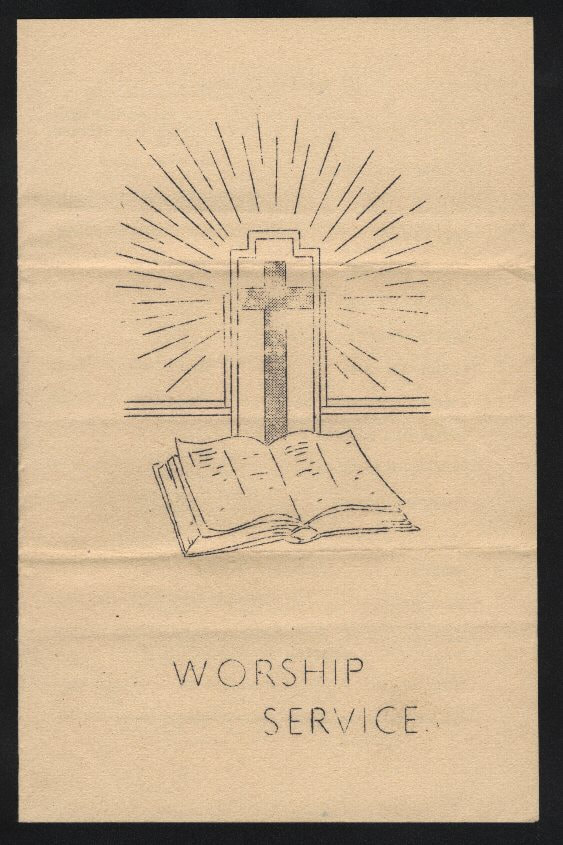
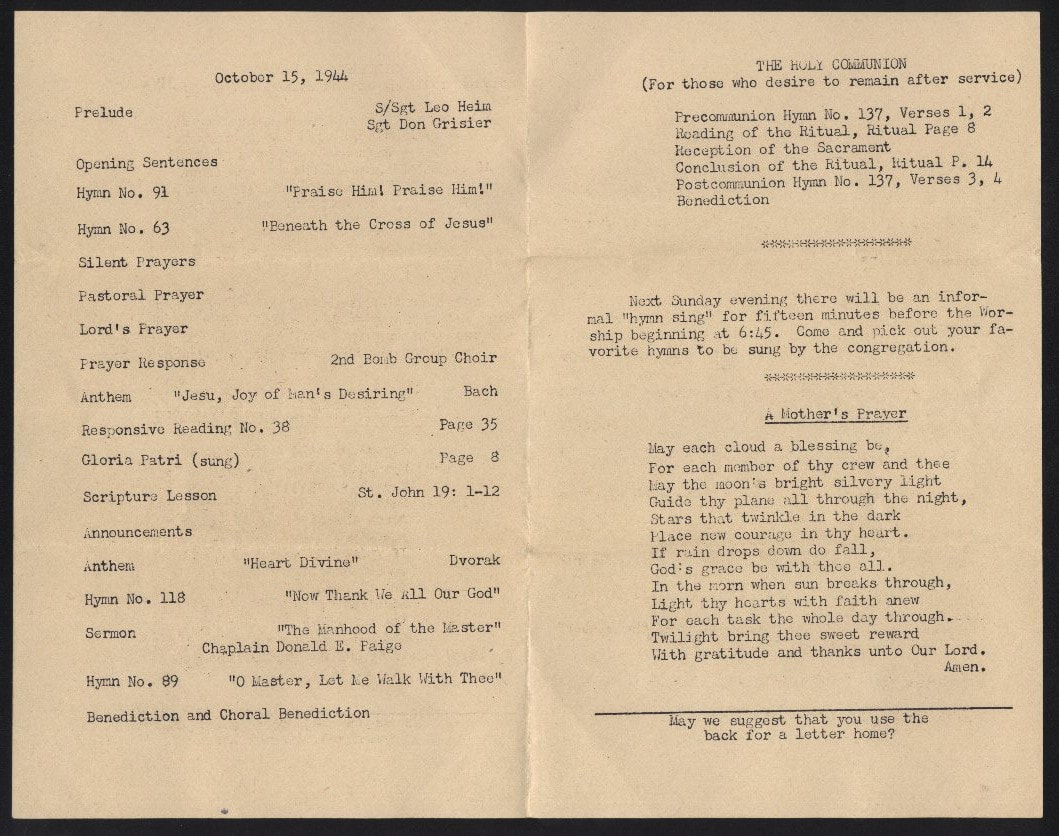
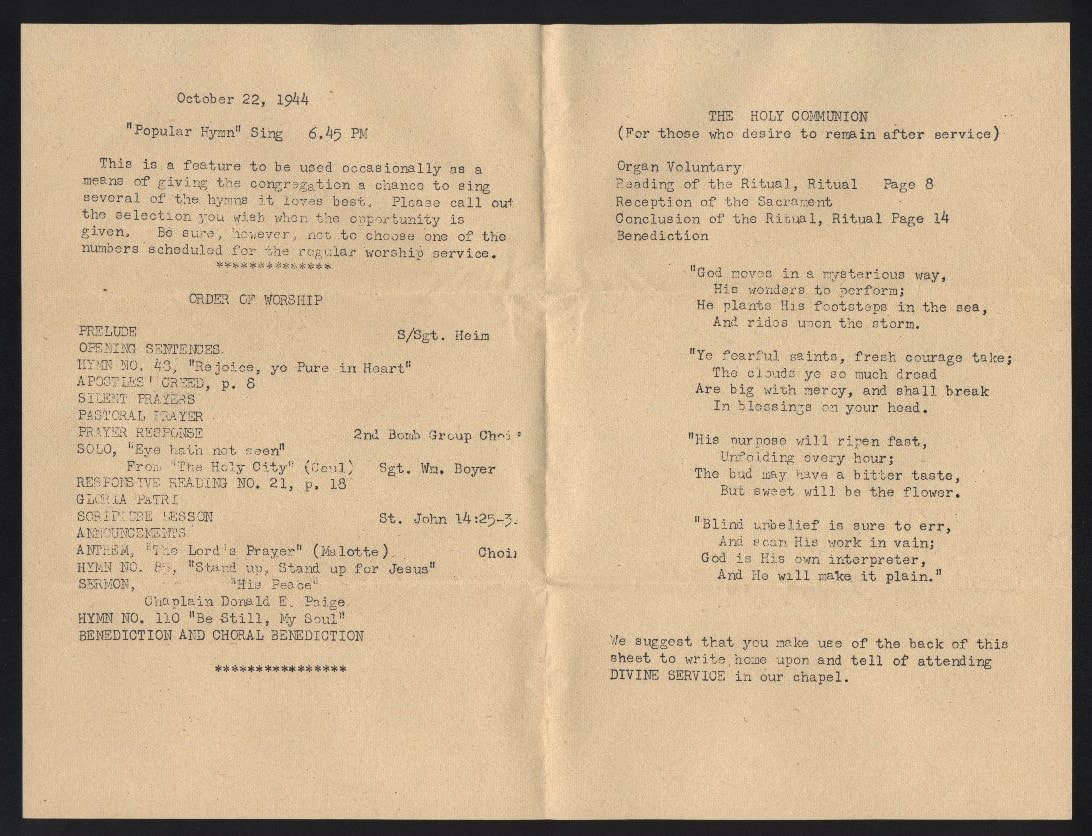
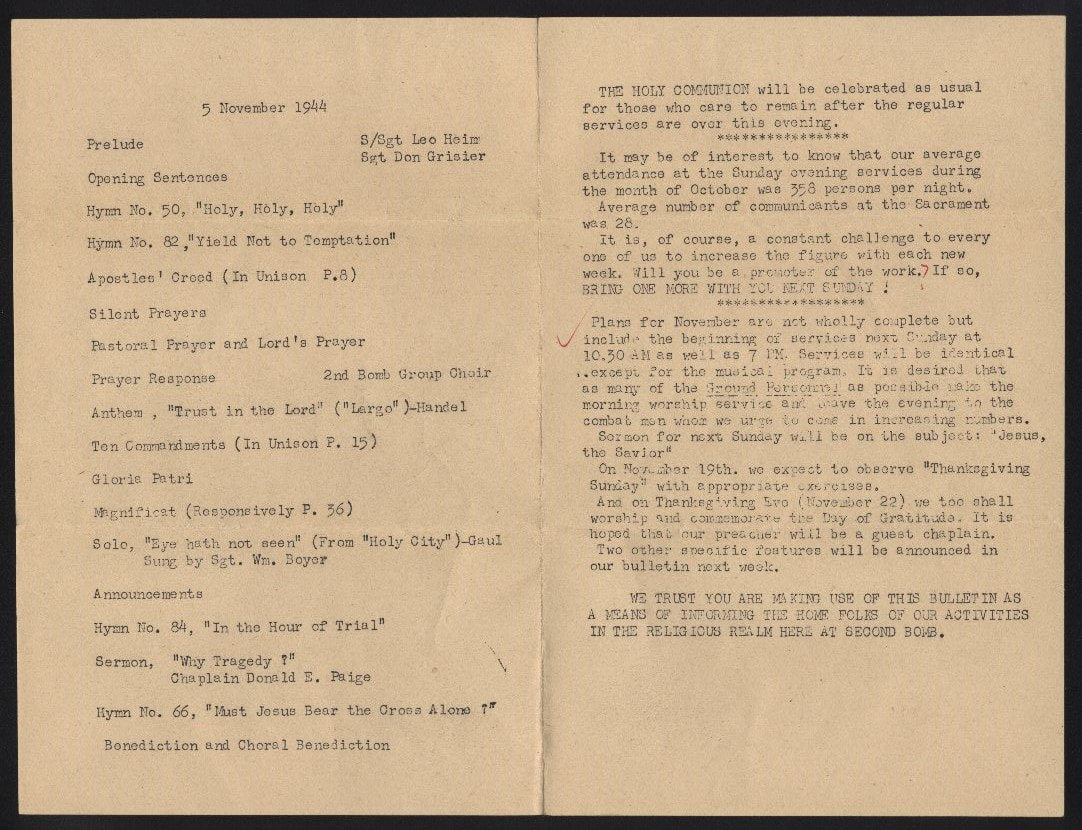
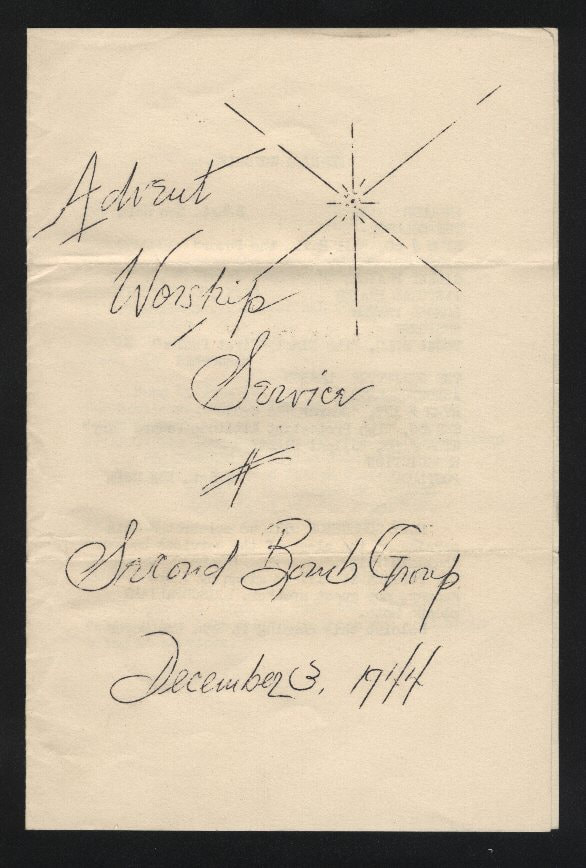
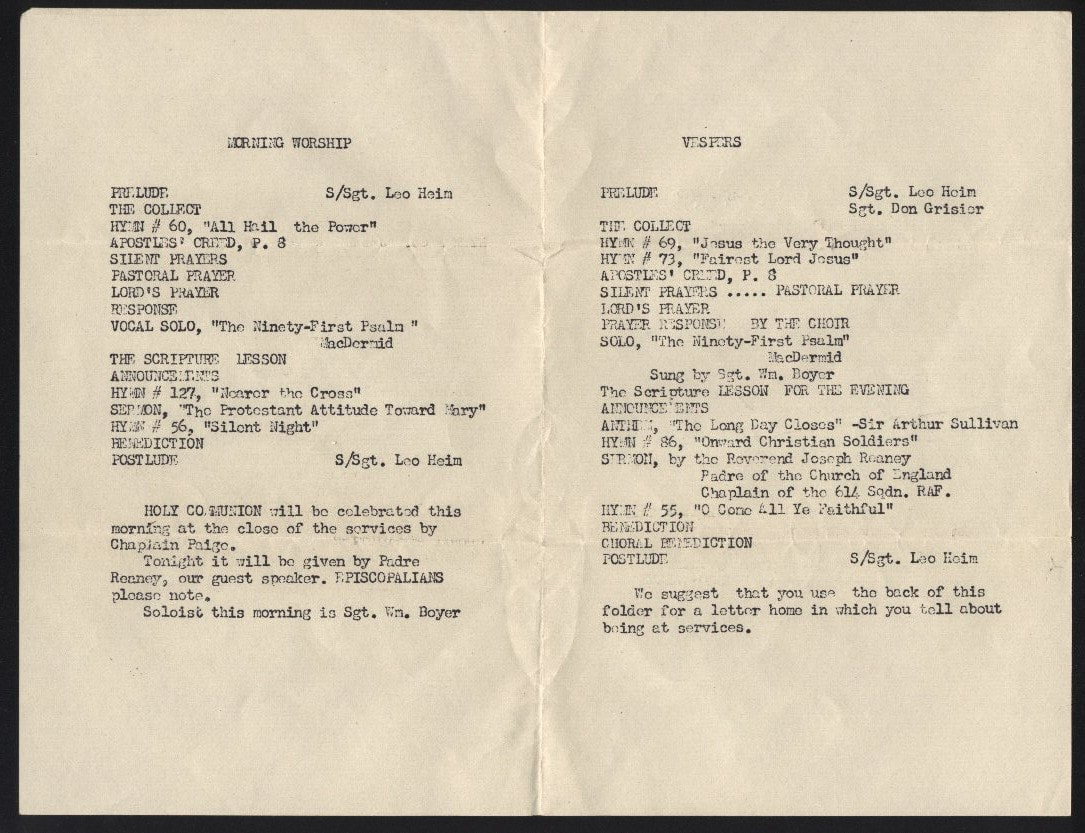
In a letter dated Sunday, October 15, Burke writes, "I am enclosing a program of the church service I just came from. This makes it three times in a row that Ed, Jack, and I have been going."

​I was surprised to hear that Burke started attending church services on October 1st. I’ve never known my father-in-law to be a religious man, so I'm not sure what prompted the change. Perhaps it was out of boredom, or perhaps he stared death in the eye one too many times—as they say, there are no atheists in a foxhole.
Picture
Picture
Picture
Picture
In several of his letters home, Burke mentioned attending "the club." In response to his family's inquiries, he clarified that in a letter dated 19 Oct 1944. "It is the 2nd Gunnery club, which is an Army club. We eat all our meals there and they have a bar and at night we can get sandwiches and coffee. There are two big fireplaces at each end and two small firplaces in on side of the building. It is all made out of stone. The kitchen is in back and to one side. Along the walls are the ensignias of differnt groups of the 2nd Bomb Group." 

On 24 Oct, 1944, Burke wrote home, "I now have 31 missions in. When I came in to the squadron 31 missions looked a long way off. I am leading my own in missions. It seems in every Group they are short of navigators and therefore, navigators finish up first."
"Now for the news from Italy. The only thing I know to write about now is that I made 1st Lt on October 30. The order just came through. How do you like that?," Burke asks in a letter dated 6 Nov 1944.

  • NOV 4  - Regensburg, Germany - Winterhaven Oil Storage
  • NOV 7  - Mirabor, Yugoslavia - 900 box cars in the Yards
  • ​NOV 11  - Brux, Czechoslovakia
  • NOV 18  - Vienna, Austria - Florisdorf Oil Refinery
  • NOV 19  - Vienna, Austria - Wintershafen Oil Refinery​​
Picture
Amendola Air Base, Foggia, Italy - home to the 2nd Bomb Group
As of 5 Nov 1944, Burke had 33 missions under his belt. "I now have 33 missions in. I am not going as fast now due to bad weather. Also they have gotten more crews in the squadron lately."

November 10th - Camera Alert - "I got three Xmas packages. The packages with the bulbs and the one with the socket and knife. I haven't received the camera yet. And I also haven't got the 75 w bulb. But they will get here eventually."

November 11th "was Armistice day, and the 2nd Bomb Group celebrated it's 300th mission! They had a dinner and dance. Colonel Twining and Colonel Lawrence was there and each made a little speech. It sure was a big affair."


Burke reports on November 16th, "I now have 36 missions in. It won't be long until I hit 40."  He is also still waiting, with bated breath, "I hope I get the camera soon."

Burke keeps inching his way towards the magic number of 50. "I now have 38 missions in. It won't be long till I have my 50 missions in," he writes in a letter dated 18 Nov 1944.

It's been 2½ months since Burke first requested a camera, and he is still waiting. In a letter dated November 21, he writes, "I got some more Xmas packages from you yesterday so now I have received 8 packages from you. I believe I have one more coming with the camera in it. Is that right?"
November 23, 1944 - Thanksgiving Day - Burke writes home, "Sunday I am going to rest camp for a week which is OK with me. At rest camp a person doesn't have a thing to do but take it easy. It is just like a vacation. I will write you from rest camp and tell you all about it."

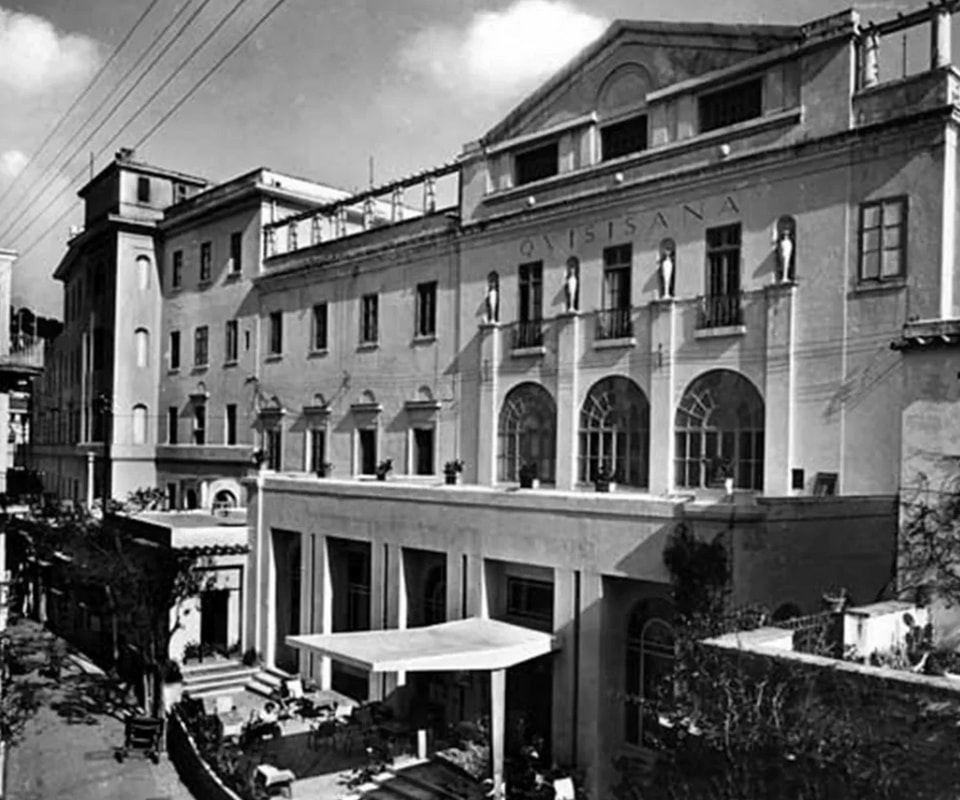
The weather reports were bad for the next several days, so the CO let the officers go to "rest camp." On November 26th, Burke, and his crewmates, Ed Bender, Earl Ruhlin & Jack Myers, hopped a flight to Naples, then caught the ferry for a ride across the Bay of Naples, to the fabulous Isle of Capri. They took the Funicular from Marina Grande, up the steep grade to the town of Capri, where they spent a few nights at the Quisiana Hotel. 
Picture
The Quisiana Hotel in Capri, during WWII
The boys hired an old local guy to be their official guide, and paid him 100 lira per day, or $1.00 American. They visited the Blue Grotto by boat, and took a donkey ride up the mountain side to Tiberius Caesar's palace ruins, where they stole a few tiles from the driveway to his villa. They went up the other side of the island to Anacapri. But the boys were bored. They were looking for some night-life (women), and Capri only offered skanky ladies of the night.

So off they went to Naples, where they rented a small villa for three nights. On Ruhlin's urging, the group decided to throw a "great Neapolitan bash," or Roman orgy. The crew had brought every bit of trading material they had, including cigarettes, soap, candy bars, K-rations, etc. to sell on the black market. By the time evening rolled around they had accumulated a bounty of cash, vino, lots of fruit, and whatever food was available. In addition they hired a string quartet and an accordion player who also sang! While hawking their wares, the boys invited every pretty girl they saw to the party, and told them to spread the news. 

The party started out great. Five fighter pilots showed up with some American whiskey, and two women they had met earlier in the day, Maria and Sophia Carlos, arrived with half a dozen female friends. By 10:00 it started getting out of hand when several more women, and four sailors wandered in, but it was still under control. Until an Italian pimp showed up, with three of his girls. The sailors started beating up the Italian pimp, the three prostitutes started beating on the sailors, and a riot broke out. When the landlord threatened to call the police, Burke and his crew gathered up their belongings and fled out the back door, with the Carlos sisters in tow. They made their way to the Carlos's home, where they were welcomed by "Mama" Carlos. That's where they would spend the night.

The next morning they headed south, taking a couple of days to visit Mt. Vesuvius, and Pompeii. But Ruhlin was tired of looking at history and convinced the boys to go back to Naples. After a couple more days of revelry, on December 3, they hitched a flight back to the base on a B-25. All the way back they laughed and talked as they relived the great times they had on their little vacation away from hell.

Burke made it back to the base in time to write a short letter to his family, and attend church at night. "I am now back in camp. I sure had a good time at rest camp. Now if I can finish up, everything will be OK. I had a few letters when I got back. But I still haven't received the packages with the camera in it. I got two rolls of film. Well I guess this is all for now. I went to church tonight as you can see." 
Picture
Picture
On December 4th, Burke writes, "I went on a practice mission today. Today was non-operational. The weather has been bad lately. I haven't been on a mission since November 19. I am not moving as fast as I did when I got here."

In a letter dated 5 Dec 1944, we find Burke lamenting over the weather, and his wayward camera. "It's getting harder and harder to find something to write about. There hasn't been much flying due to the weather. I hope I can finish up this month. I have only 12 more missions to go. I still haven't gotten the packages with the camera in it. I hope it isn't lost or something."

Since the bad weather was the bane of Burke's existence, he shares a lecture about weather in his letter dated 6 Dec 1944. "I flew today but it was only a practice mission. Did I tell you I was a Flight Navigator? I lead the squadron when the squadron is flying in the group. I sure hope the weather clears up a little bit so a fellow can get a few missions in. From the letters you get you  must think the weather is bad. Well don't forget, the weather may be good at the base but we travel a good many miles to our targets and the weather at the targets are bad. It is like raining in Chicago and the sun is shining in Palmyra (NJ). The same thing. Some of the missions we go on are as long as the distance is from home to the farm (Indiana) so you can see we could encounter all kinds of weather. Clouds look puffy from the ground, but to fly in them is another story. Well enough for the lecture on weather. How is everything and everybody at home? I am in the best of health here in Italy. A Merry Xmas to all. Love, Burke"

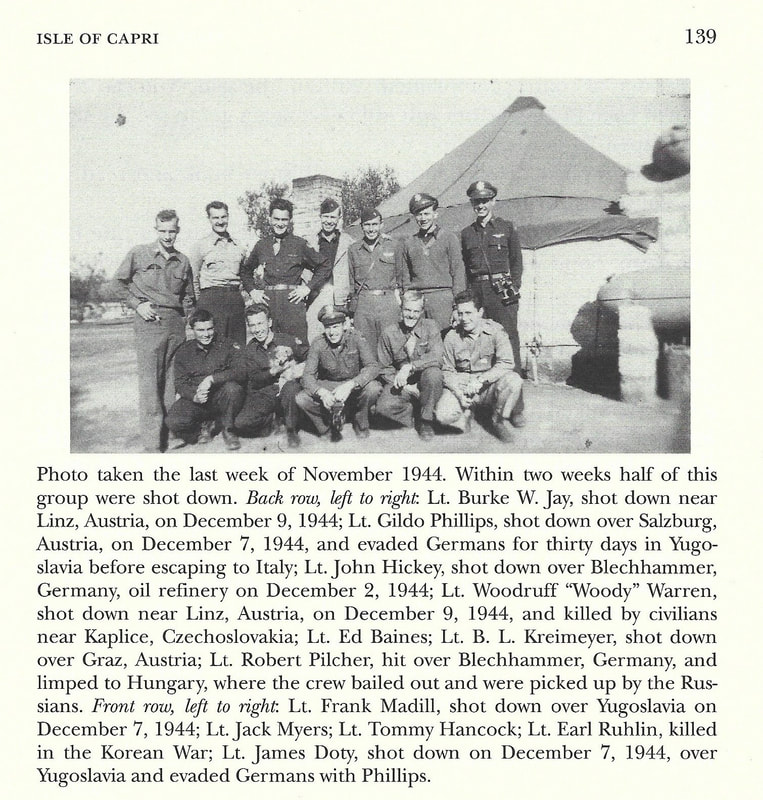
Still lamenting about his camera, Burke sent a picture home to his family of some of the crewmates in his squadron. In a letter dated 8 Dec 1944, he writes, "It is very windy tonight and the sky is black. I don't know if there will be any mission tomorrow or not. I still haven't gotten the package with the camera in it yet. Here is a picture of some of the fellows that are in my squadron. The fellow holding the dog is Jack, my bombardier. Well I guess this is all for now. Love, Burke"
Picture
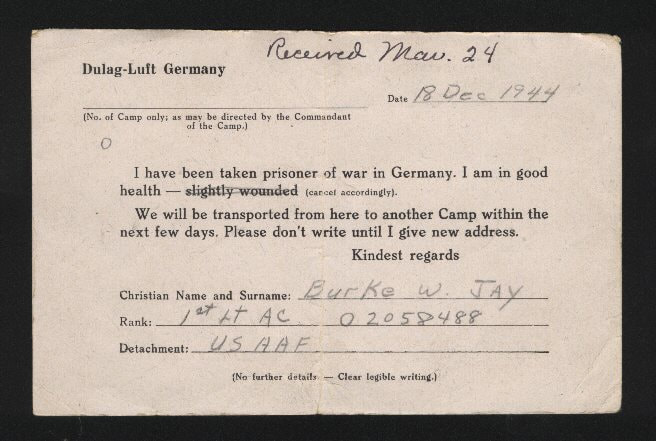
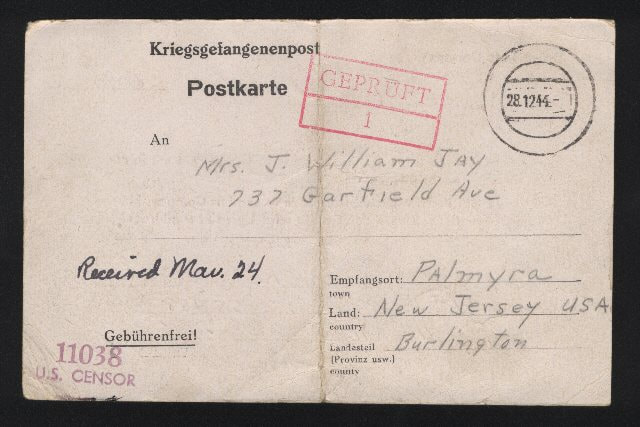
Although Burke was typically diligent about writing to his mother every day—never missing more than two days in a row, except during his time in Capri and Naples—there is a notable gap after December 8th, 1944. His next communication was not sent until December 18, 1944, ten days after his previous letter, which was entirely out of character for him. The correspondence was a postcard in which he informed his mother that he had been taken as a Prisoner of War.
Picture
Picture
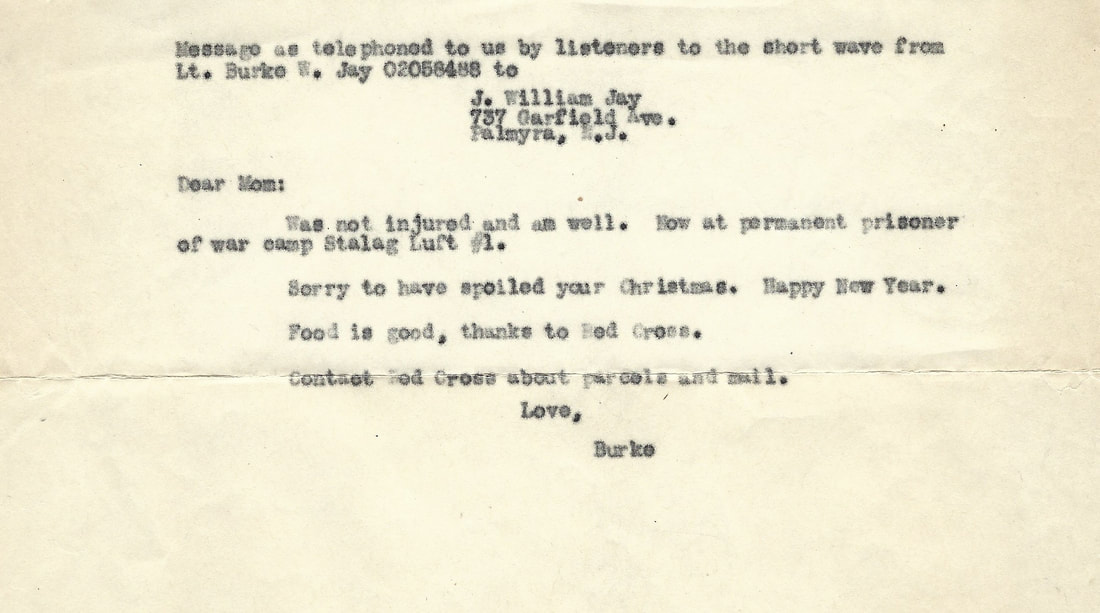
Date Unknown: Message as telephoned to Burke's family by listeners to the short wave from Lt. Burke W Jay  02058488  to:  J. William Jay, 737 Garfield Ave, Palmyra, NJ
Picture
Dear Mom:
Was not injured and am well. Now a permanent prisoner of war camp Stalag Luft #1.
Sorry to have spoiled your Chrismas. Happy New Year.
Food is good, thanks to Red Cross.
Contact Red Cross about parcels and mail.
Love,
Burke

​www.Gezellig-NePA.com
Robyn Madara Jay & WIlliam (BJ) Jay
Bloomsburg, PA  17815
© 2026
Robyn Madara Jay, Webmaster
Picture