GEZELLIG-NEPA.COM
  • Home
  • Gezellig Services
    • Rhythmic Connections
    • Listening Room
    • Briggs Farm Blues >
      • Blues 2025
      • Blues 2016
      • Blues 2010
    • Area 51 >
      • A51 Season 1-3
      • A51 Season 4-6
      • A51 Season 7-9
      • A51 Season 10-12
    • Columbia-Montour Visitors Bureau
  • About Us
    • Our Herstory 1970s >
      • Tin Ear Sound & Stage
      • Ozymandias
      • Goodman Brothers
      • Summer of 76
      • Folly Magazine
    • Our Herstory 1980s >
      • COMMUNITY
      • ACTIVISM
    • PETS
    • Quilting
    • FART
  • Travel
    • Fodor's
    • Bloomsburg, PA
  • Genealogy
    • Madara History >
      • Joseph Madara Sr WWII
      • Madara Swiss Ancestors
      • Madara Revolutionary War
      • Gilberton Sensation
      • Madara Photos
      • Madara Reunions 1964-1997
      • Madara Reunions 2013-present
    • Kehres History >
      • Kehres Photos
    • Jay History >
      • Burke W Jay WWII
      • Who's Henry Goldner
      • Goldner Years
      • Thomas Hunt of Grove Farm
      • Edward Jessup of West Farms
      • Jay Photos
  • Contact
  • Home
  • Gezellig Services
    • Rhythmic Connections
    • Listening Room
    • Briggs Farm Blues >
      • Blues 2025
      • Blues 2016
      • Blues 2010
    • Area 51 >
      • A51 Season 1-3
      • A51 Season 4-6
      • A51 Season 7-9
      • A51 Season 10-12
    • Columbia-Montour Visitors Bureau
  • About Us
    • Our Herstory 1970s >
      • Tin Ear Sound & Stage
      • Ozymandias
      • Goodman Brothers
      • Summer of 76
      • Folly Magazine
    • Our Herstory 1980s >
      • COMMUNITY
      • ACTIVISM
    • PETS
    • Quilting
    • FART
  • Travel
    • Fodor's
    • Bloomsburg, PA
  • Genealogy
    • Madara History >
      • Joseph Madara Sr WWII
      • Madara Swiss Ancestors
      • Madara Revolutionary War
      • Gilberton Sensation
      • Madara Photos
      • Madara Reunions 1964-1997
      • Madara Reunions 2013-present
    • Kehres History >
      • Kehres Photos
    • Jay History >
      • Burke W Jay WWII
      • Who's Henry Goldner
      • Goldner Years
      • Thomas Hunt of Grove Farm
      • Edward Jessup of West Farms
      • Jay Photos
  • Contact

Burke W Jay WWII History

He went in as a boy, came home as a man.
Picture
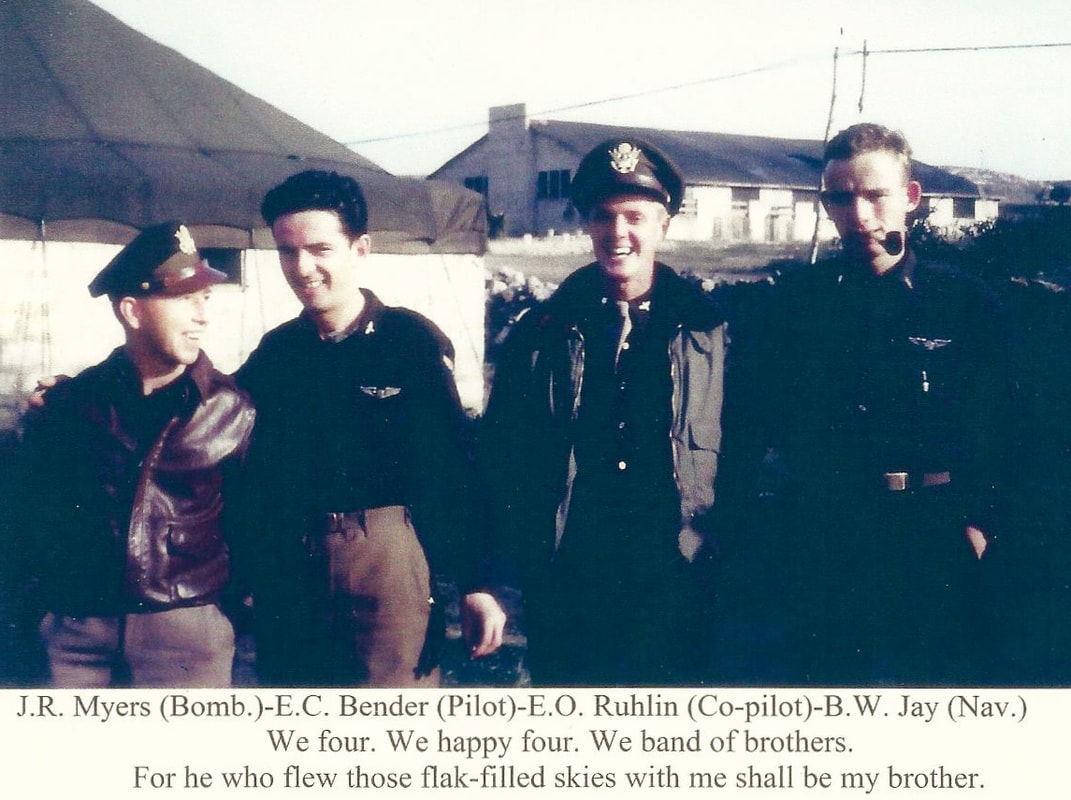
​This webpage is dedicated to my father-in-law, Burke W Jay, who served during WWII as a navigator on a B-17 bomber, and was shot down over Czechoslovakia on 9 Dec 1944.  Burke was one of four crew members who survived - the other six were executed by the Nazis - and  he and his crewmates served out the remainder of the war as POWs in Stalag Luft 1, until being liberated by the Russians in May 1945. Thank you for your service, Burke. You are our hero.
Picture
Picture
Picture

Picture
Church of the Holy Stone in Kaplice, Czech Republic
Picture
Memorial at church in Kaplice, honoring all 10 crew mates.
Picture
MEMORIES - Dedicated by the village of Dolní Dvorište in 2004.
Picture
Picture
Picture
Picture
Needlepoint made in POW camp of the 4 crew members who were captured. Lt. Jay, Upper left corner

Burke's Military History

9 Dec 1942 - 13 Oct 1945
Burke was attending Drexel University in Philadelphia, pursuing a degree in Mechanical Engineering, when the attack on Pearl Harbor occurred. By law, all males 18-64 had to register for the draft (before Pearl Harbor it was 21-35), so Burke completed the Registration Card on February 14, 1942.
Picture
Picture

​But Burke was anxious to help with the "war effort," and instead of waiting to be drafted, he made plans to enlist. In November 1942 he solicited recommendations from several of his educational contacts.
Picture
Picture
Picture
Despite his mother’s objections, Burke enlisted in World War II one year and two days after Pearl Harbor, on December 9, 1942. This marked the beginning of a three-year journey that would take him through the depths of hell and back.
Picture
Picture

​Induction & Boot Camp  ~  Miami Beach, Florida
February 1943 - March 1943
Because of his two years of Mechanical Engineering training, Burke was a prime candidate for an aviation position in the Army Air Force. Once his training began, he was sent to Miami Beach, Florida, where he attended a four-week induction and Boot Camp that concluded at the end of March 1943.
On February 28, 1943, Burke wrote the first of many pieces of correspondence to the "folks" back home, including his mom, father, and sister Dorothy. Each letter was signed, "Love, Burke."

In 2005, I transcribed the collection of 175+ letters and memorabilia into a book for his children and descendants. I am using this book, along with other sources, to document Burke's war experience.
​
Picture
Transcript on postcard - Dear Folks, How do you like this card? It is the truth. I just had some more shots. One kid went out completely. But it doesn't bother me. I will send a letter later. I got the hangers. Thanks! Love, Burke   ~   Postmarked March 2, 1943  5:30 pm  Miami, FL
Picture
Picture
Picture

​Wittenberg College  ~  Springfield, Ohio
April 1943 - July 1943
By April 3, 1943, Burke had arrived at his next destination - Wittenberg College in Springfield, Ohio - where he would spend the next three months being schooled in physics, math, history, military english, geography, medical aid, and civil air regulations, as part of the 54th CTD.​
From 1943-1944, the U.S. Army Air Forces (USAAF) established over 150 College Training Detachments (CTDs) at universities to provide accelerated academic, physical, and pre-flight training to aviation cadets. These programs, lasting about 5 months, prepared recruits for pilot, navigator, or bombardier training. Wittenburg College was the 54th CTD.
Picture
Picture
When Burke arrived at Wittenberg College, he was initially assigned to Squadron D, but later re-assigned to Squadron C in June.
Picture
Squadron D Passes in Review at Parade
​May 28, 1943


​Wittenberg College and The War-Training Program
Picture
Picture
Picture
Picture

​Snapshots from the 54th CTD - Springfield, Ohio - 1943
Picture
Picture
Picture
Picture
Picture
Picture
Picture
Picture
Picture
Picture
Picture
Picture
Picture
Picture
Picture
Picture
Picture
Picture
Picture
Picture

​Army Life  ☼  The Star in God's Window
Picture
Picture
Picture
Picture

Other ​54th CTD Publications
Click on image to download PDF file
Picture
Class of July 1943 Graduation
​32-page downloadable PDF
Picture
Squadron D Diary
​26-page downloadable PDF 
Picture
Community Recognition Day
​4-page downloadable PDF
Special THANK YOU to the Francis W Holden Collection, administered by
​ the Army Air Forces Collection (aafcollection.com), for the digital pamphlets used in this section.

​Postcards of Springfield, Ohio
Picture
Picture
Picture
Picture
Picture
Picture
Picture
Picture
Picture
Picture

​Pre-Flight School  ~  Santa Ana Army Air Base, California
August 1943 - November 1943
By the end of July 1943, Burke was on the move again, this time heading towards Santa Ana Army Air Base in California, for Pre-Flight training. As he traveled across the country, he sent a series of postcards home to New Jersey.
July 31, 1943
Molto, Colorado
Dear Mom,
I am on my way to Santa Anna. Having a nice trip. I believe I will live in Colorado after the war.
Love,
Burke
August 1, 1943
Salt Lake City, Utah
Dear Mom,
Here I am in Salt Lake City as any fool can see. Having a nice trip,
Love, 
​Burke
August 2, 1943
Los Angeles, California
via Telegraph
Arrived in Los Angeles
4:30  August 2
2 hours open post.
Write later.
Love,
Burke
On August 3, 1943, and travelling by train, Burke finally arrived at his destination. He was given a "form letter" to fill out and send home to family, along with a small booklet, Army Emergency Relief and You.
Picture
Picture
Picture
Picture
Picture
Picture
Picture
Picture
Picture
Picture
Santa Ana Army Air Base (SAAAB) was an air base without planes, hangers, or runways. It was a huge basic training camp where newly inducted soldiers, earmarked for the Army Air Forces, were given 9 weeks of basic training and then testing to determine if they were to be pilots, bombardiers, navigators, mechanics, etc. From SAAAB, they went on to other bases for training in their specialties.
Picture
Settling into his new barraks, on August 5, 1943, Burke sent a letter back home, kvetching about the Army's methods of making beds.
Picture
Picture
Burke passes the pressure chamber tests, and explains the process, in a letter to home, dated August 29, 1943. This opens his way towards Pre-Flight Training.

​In a letter to Burke's parents from the War Department, dated September 10, 1943, 
they are informed that the Classification Board has selected Burke for training as a Bombardier in the Army Air Forces.
Picture
Picture
Picture

​After weeks and weeks of training and testing, the final letter that Burke wrote from the Santa Ana Army Air Base, on November 9, 1943, was to inform folks back home that he had finished Pre-Flight School, had been switched to Navigator (which was a better deal) instead of Bombardier, and he would be shipping out in a week or two, to an unknown destination. 
Picture
Gunnery School  ~  Las Vegas Army Air Field, Nevada
​November - December, 1943
In a letter dated November 19, 1943, we discover that the unknown destination is Gunnery School at the Las Vegas Army Air Field (LVAAF), in the middle of the desert, nine miles from Las Vegas, Nevada. Burke is living in a tent, with a small bucket-a-day stove to keep warm. The nights are cold, the days are hot, and the wind blows fine particles of sand in the air. Burke will spend the next six weeks attending gunnery classes, the last two weeks flying in B-17s, also know as the Flying Fortress.
​The Las Vegas Army Air Corps Gunnery School, established in 1941 and opened in 1942, was the premier WWII training facility for aerial gunners. It was held at the Las Vegas Army Air Field, later becoming Nellis Air Force Base. The School trained over 45,000 gunners for B-17, B-24, and B-29 bombers using, among other techniques, unique "frangible" bullets and live-fire exercises in the Nevada desert.

Aviation cadets were trained in "flexible gunnery," a six-point program. Key training elements included:
  1. Flexible Gunnery Techniques
  2. .30 and .50 Caliber Training
  3. Lead Computing Sights
  4. Target Identification
  5. Range Estimation
  6. Simulator Training. ​
Picture
E-5 Trainer
Picture
Airial Gunnery Simulator
(Photos By: Historic Army Air Corps Photo)
For the first time in Burke's life he would spend Christmas away from home and his family. Instead, he was in the desert, finishing up his final week of training, and stuck with K.P. on Christmas Eve!

The good news... He finished his training at LVAAF​ and, after almost a year, he is finally going home on a short leave!!!
After the New Year (1944), once again, Burke started packing up all his worldly possesions as he would be heading to Hondo, Texas after his 13 day leave was up. 
Picture
Travelling by train from Nevada to Pennsylvania to Texas
  • ​Jan 4   -  Left Las Vegas, Nevada
  • Jan 8   -  Arrived home, New Jersey
  • Jan 14 -  Left for Hondo, Texas
  • Jan 16 -  Arrived Hondo, Texas
Picture
Navigation School  ~  Hondo Air Base, Texas
Jan 1944 - May 1944
Picture
Burke's parents received a letter from the War Department dated January 17, 1944, informing them of Burke's acceptance into Navigation School. The Army encouraged his parents to "Write to him often and keep him happy in order that his mind may be free to assimilate the course of instruction."

Burke had a harrowing train trip from New Jersey to Hondo Air Base, Texas. In a letter dated January 18, 1944, Burke writes, "The train was 5 hours late in getting to St Louis and the other train was 2 hours late. But I got to Hondo in time. I was in bed at 23:45 Sunday night (16th). I stood up all the way to Pittsburg [from New Jersey]. That was some ride."​
The plans for Hondo Air Base were conceived shortly after Pearl Harbor. Following three months of planning and three months of construction, Hondo Air Base was officially activated on July 4, 1942.

During its 3½ years of operation Hondo Air Base produced approximately 14,000 Navigators, 3000 Glider Pilots, and 300 B-29 Flight Engineers. The Air Base was deactivated on December 31, 1945.
On January 17, 1944, Burke would begin an intensive 18-week training course in navigation techniques and practices, including aboard an in-flight training classroom. "I will go on my first mission sometime today (Jan 30). We will fly in an AT-7. Three students in a plane with one pilot and one instructor. Each student has his own desk and everything he needs on the trip. It is just like a school room, only in an airplane," according to Burke.

For 18 Sundays in a row, beginning with January 23, 1944 through May 14, 1944, Burke faithfully spent the evenings writing letters home to his Mom and family. (Thanks, Burke!)
Picture
An AT-7 plane, used as a classroom.
Rain and fog grounded Burke's initial mission, due to "the ceiling was 0 and no flights took off." It would be another two weeks, and finally, on Saturday, February 12th, 1944, Burke flew his first mission as a Navigator, and he "didn't get lost!" Starting in Hondo, he navigated the plane to Temple, then to Wharton, and back to Hondo. "It was a nice trip. It took 3 hours and 45 minutes flying time," wrote Burke.

Unfortunately, the bad weather continued, and it would be another 2+ weeks until his second mission. "The weather is still bad here. I went up in one more mission and it sure was rough. I didn't get sick but the two other fellows in the plane got sick. It was sure rough and we had to fly about 1000' above ground in order to take drift."
March brought better weather, and the opportunity for Burke to get some missions under his belt, including flying to Witchita Falls, Dallas, San Angelo, Dawson, and Richmond, all located in Texas. In April he flew out-of-state, to Morre, Louisianna; Colorado Springs, Colorado; and Des Moines, Iowa, which was his final and "combat mission."  He passed ALL his tests, and graduated from the rank of Aviation Cadet to a Navigator, 2nd Lt. 

The Army Air Forces Navigation School 
announces the graduation of Class 44-7
May 20, 1944
Picture
Picture
After graduation, Burke left Texas for home, arriving in New Jersey on May 23, 1944, and spending a week with his family. On May 31, 1944 he left for his next assignment, in Tampa, Florida.

Picture
Picture
Picture
Picture
Picture
Picture
Picture
Picture
Picture
Picture
Picture
Picture
Picture
Picture
Picture
Picture
Picture
Picture
Picture
Picture
Picture
Picture
Picture
Picture
Picture
Picture
Picture
Picture
Picture
Picture
Picture
Picture
Picture
Replacement Training Unit  ~  Drew Field, Tampa, Florida
June 1944 - August 1944
Drew Field, Tampa, Florida, provided large signal air-warning training and engineering aviation training for heavy bombers during WWII. One-thousand 10-man combat bombing crews were organized and trained to work together, preparing to ship-out during the war. 
On June 2, 1944 Burke arrived in Tampa, Florida after "the dirtiest ride I ever had on the train." A few days later, while the June 6, 1944, D-Day Invasion of Normandy was taking place, Burke was sitting in a dentist chair having a wisdom tooth pulled, but also reflecting on the invasion and his future. "Well it looks like the invasion is on. I don't know how that will effect me. Maybe I won't go to England and instead go to the South Pacific."

Apparently Burke had ongoing dental problems and the Army decided that they must drill out all of his old fillings and replace them with new ones using a "special method of filling teeth for fellows who fly." 
Picture
When he wasn't sitting in the dental chair, he was flying missions. "I have been on three missions so far, none of them have been navigation missions. All we have been doing is dropping bombs. I am suppose to learn how to use the sight and drop 10 bombs that should be good."

By the end of July we find Burke in the hospital at Drew Field, with a sore throat, swollen glands, and a temperature. He's getting antsy, fearful that his crew would ship out without him. "All I do is read books and drink fruit juices and eat three meals a day and stay in bed. It's the best deal I have had in the Army yet."

On August 9, 1944, Burke was finally discharged from the hospital. He immediately left Drew Field in Tampa and arrived at Hunter Air Field, in Savannah, Georgia the next day, August 10th, joining up with his crew.

Picture
Shipping Out  ~  Hunter Army Air Field, Savannah, Georgia
​August 1944
Burke arrived at Hunter Army Air Field on August 10th, 1944 and rejoined with his crew. On the 12th the crew was assigned their plane. "We got out air plane today and flew it for 3 hours. It sure is a nice plane. I guess it just came from the factory." (Billy's question, Did it have the "new plane" smell?)

Preparing to go over-seas, Burke sent home his driver's license and fraternity card, and his postal address was reassigned.

Picture
Picture
Picture
Picture
Around the 15th of August, Burke and his crew began the long trip to Italy in their new B-17 bomber  plane, their Flying Fortress.

They would take the South Atlantic route, flying from Georgia to Florida (Morrison Field), then through Puerto Rico, British Guiana, Brazil, across to Dakar, French West Africa, and finally to North Africa or Italy.  By August 29, 1944, the crew had finally arrived in Italy.
Training is over - Combat begins.

​www.Gezellig-NePA.com
Robyn Madara Jay & WIlliam (BJ) Jay
Bloomsburg, PA  17815
© 2026
Robyn Madara Jay, Webmaster
Picture